
Google’s Top 5 Algorithms Explained in Simple Term
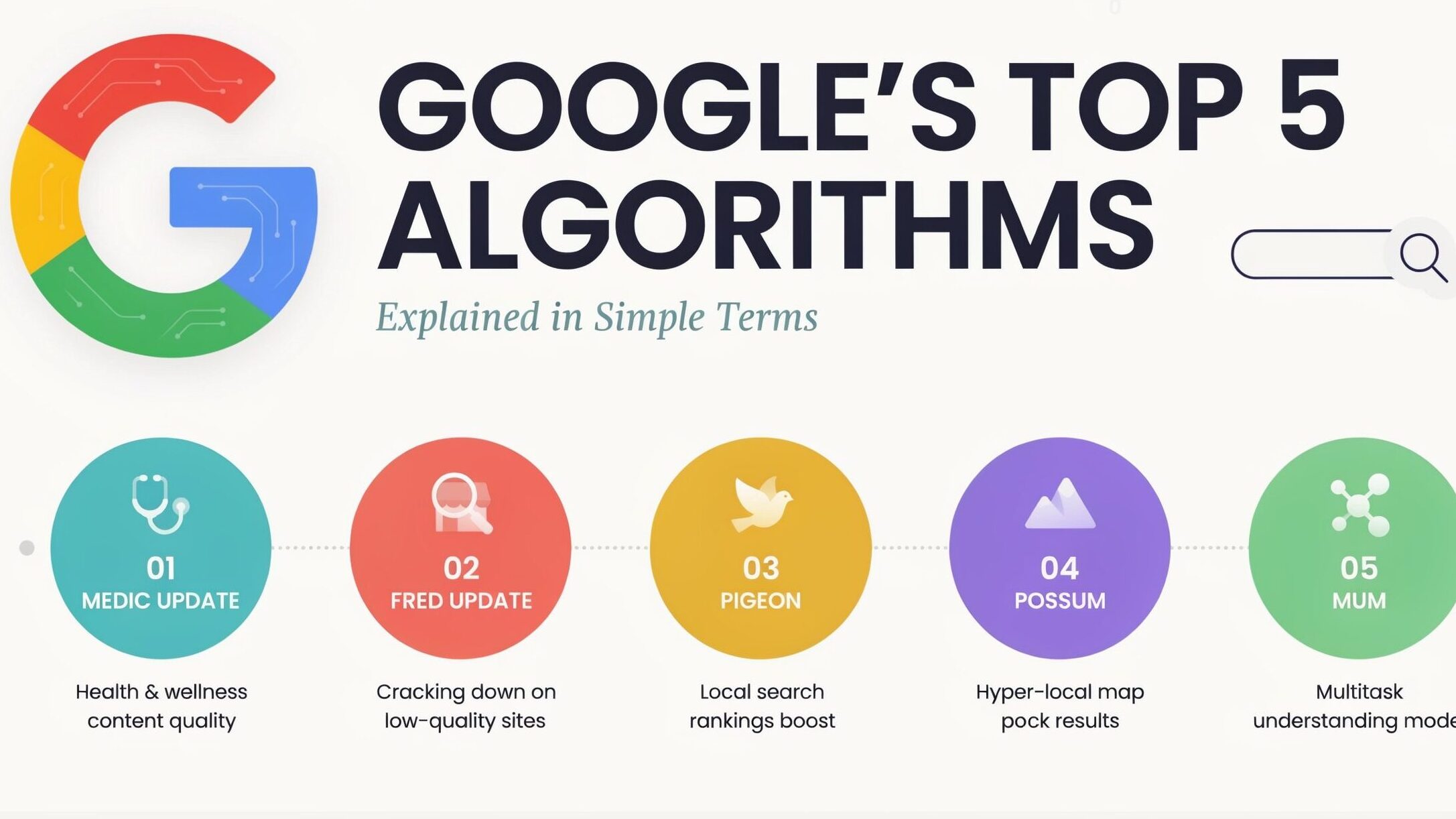
Getting your website to the top of Google isn’t just about luck. Behind every search result is a system of algorithms that decides which pages deserve the highest rankings ?The answer often lies in Google’s search algorithms. These algorithms evaluate millions of web pages to determine which ones provide the most relevant, trustworthy, and helpful information for users.
Google regularly updates its algorithms to improve the quality of search results and ensure users find the best possible answers to their questions. For businesses, bloggers, and digital marketers, understanding these updates is essential for building a strong online presence.
In this blog, we’ll explore five important Google algorithms that have significantly influenced SEO: Medic Update, Fred Update, Pigeon, Possum, and MUM. Knowing how these algorithms work can help you create better content, improve your website, and increase your chances of ranking higher on Google.
1. Medic Update
The Medic Update, introduced in 2018, is one of Google’s most influential core updates. While it primarily affected health and finance websites, its impact extends to any website that provides information requiring a high level of trust and accuracy.
Google wants users to receive reliable information, especially when it comes to topics that can affect their health, finances, or overall well-being. Because of this, websites with inaccurate, outdated, or poorly researched content often experienced ranking drops after this update.
Why It Matters
The Medic Update emphasizes Experience,Credible websites are more likely to rank highly in search results. Expertise, Authoritativeness, and Trustworthiness (E-E-A-T).Best Practices
- Publish accurate and well-researched content.
- Keep information updated regularly.
- Include credible sources when appropriate.
- Showcase author expertise and experience.
- Build trust through transparent business information and secure browsing.
Key Takeaway:
If your content helps users with important decisions, quality and credibility should always come first.
2. Fred Update
The Fred Update, released in 2017, targeted websites that focused more on generating advertising revenue than providing useful information to visitors.
Many websites filled with excessive ads, thin articles, and low-value content experienced significant ranking losses. Google’s goal was simple: reward websites that genuinely help users instead of those created primarily for profit.
Why It Matters
Best Practices
Google values content that answers users’ questions and provides real value. Pages overloaded with advertisements or written only to attract clicks are less likely to rank well.
- Write original, informative articles.
- Limit intrusive advertisements.
- Avoid clickbait headlines.
- Focus on solving readers’ problems.
- Improve readability with headings and bullet points.
Signs Your Website Is User-Friendly
- Clear navigation
- Fast loading speed
- Helpful content
- Minimal distractions
- Easy-to-read formatting
Key Takeaway:
Create content for people first, not just for search engines or ad revenue.
3. Pigeon
The Pigeon Update, launched in 2014, significantly improved Google’s local search results. It helps users discover businesses and services located near them while making local search results more accurate and relevant.
Whether someone searches for “coffee shop near me” or “best digital marketing agency,” Pigeon works to display businesses based on location and relevance.
Why It Matters
Local SEO has become increasingly important for businesses that serve customers within specific geographic areas.
Benefits of the Pigeon Update
- More accurate local search results.
- Better visibility for local businesses.
- Stronger connection between Google Search and Google Maps.
- Improved relevance for location-based searches.
Local SEO Tips
- Create and optimize your Google Business Profile.
- Maintain a constant phone number, address, and business name.
- Encourage satisfied customers to leave reviews.
- Use location-specific keywords naturally.
- Add local content to your website.
Key Takeaway:
If your business serves a local audience, optimizing for local SEO is essential for attracting nearby customers
4. Possum
The Possum Update, introduced in 2016, refined how Google displays local search results. Its purpose was to provide users with greater variety by filtering duplicate listings and considering the searcher’s location more carefully.
This update allowed businesses located just outside city boundaries to compete more effectively in local search results.
Why It Matters
Possum helps create a more balanced local search experience by preventing similar businesses from dominating search results.
Main Benefits
- Increased diversity in local listings.
- Better opportunities for smaller businesses.
- Improved location-based search accuracy.
- Reduced duplicate business listings.
How to Benefit from Possum
- Optimize your Google Business Profile.
- Use accurate business categories.
- Maintain consistent contact information.
- Collect authentic customer reviews.
- Publish location-focused content regularly.
Key Takeaway:
Possum rewards businesses that maintain accurate local information and provide genuine value to nearby customers.
5. MUM (Multitask Unified Model)
MUM, introduced by Google in 2021, represents one of the biggest advances in artificial intelligence for search. Unlike earlier algorithms, MUM can understand information across multiple languages and different content formats, including text and images.
It is designed to answer complex questions by understanding context rather than simply matching keywords.
Why It Matters
Today’s users ask detailed questions and expect complete answers. MUM helps Google deliver more comprehensive search results by connecting information from multiple sources.
Advantages of MUM
- Better understanding of complex search queries.
- Improved multilingual search capabilities.
- Enhanced image and text recognition.
- More accurate and comprehensive search results.
How to Optimize for MUM
- Write comprehensive, in-depth content.
- Answer common user questions clearly.
- Organize content with headings and subheadings.
- Include relevant images with descriptive alt text.
- . Pay more attention to user intent than keyword repetition.
Key Takeaway:
As search becomes more intelligent, creating detailed, helpful, and user-focused content is the best way to stay competitive.
Final Thoughts
Google’s search algorithms are constantly improving to deliver the most useful and relevant results to users. Updates such as Medic, Fred, Pigeon, Possum, and MUM each play a unique role in evaluating websites, but they all share the same objective—rewarding content that is helpful, reliable, and created with the user in mind.
Rather than trying to keep up with every algorithm change, focus on building a website that offers genuine value. Publish original content, provide accurate information, improve your site’s speed and usability, and always think about what your audience needs. These practices not only align with Google’s expectations but also help build trust with your visitors.
In the long run, successful SEO is about creating a better experience for people, not just improving rankings. When your website consistently delivers useful content and a positive user experience, you’re more likely to earn lasting visibility and sustainable growth in search results.
GET IN TOUCH FOR CONSULTATION and new algorithm updates